


The recent history of Colombian citrus changed in 2018, when the United States officially reopened its market to our oranges following approval from the USDA and its agency APHIS. Since then, a highly valuable trade window opens every year between June and September, just when Florida faces low production due to weather and seasonality. That is when Colombia has the opportunity to stand out with naturally sweet, high-quality fruit.
Celifrut stands out as a pioneer in degreening Colombian oranges
In 2018, Celifrut made the first Colombian export of oranges to the United States. However, we soon understood that to compete with giants such as Mexico, Peru, Spain, South Africa or Morocco, we had to solve a challenge that seemed minor at first glance but actually defined our competitiveness: peel color.
For U.S. consumers, color is not just an aesthetic matter; it is an indicator that an orange is ready to eat. Although our oranges had good sweetness, many arrived with green tones typical of the tropical climate. Inside they were at their ideal point, but on the outside they gave the impression of not being ready.
Orange degreening is a postharvest process carried out in chambers with controlled temperature, humidity and very precise levels of a naturally occurring gas that the fruit itself produces. This process accelerates the breakdown of the chlorophyll that keeps the peel green, allowing the carotenoids responsible for the characteristic orange color to emerge. It is the same process that would occur on the tree, reproduced through science and technology.
This technique has been developed since the middle of the last century in pioneering countries such as the United States and Spain, and refined by major exporters such as South Africa, Morocco and Egypt. Although this technology was not invented in Colombia, there is a milestone that makes us proud: Celifrut pioneered its adoption and local development for Colombian citrus.
Why was degreening necessary in a tropical country?
The reasons are clear and can be explained simply. In warm regions such as the Coffee Region (Eje Cafetero), an orange can be fully sweet without its peel developing a uniform orange color. In addition, leaving the fruit on the tree for too long increases the risk of fruit fly, a quarantine pest that the United States does not allow under any circumstances. Waiting for more color in the field is simply not viable.
Orange degreening becomes a technical, commercial and phytosanitary ally. It does not change the flavor, does not alter firmness and does not accelerate internal ripening. It simply supports a natural process that was already bound to happen.
That was the purpose with which our story of innovation began. Before 2018, there were no manuals or technical references on citrus degreening in Colombia. The first attempts at our plant involved adapting technologies from other countries to local conditions. It was a path of trial and error, constant research and many hours of work. There were fruit losses, but also lessons that today form the basis of a robust and reliable process.
At Celifrut, we developed our own technified chamber, with automated sensors, electronic control panels, real-time monitoring, alarms and standardized cycles. We went from operating manual valves and fans to a modern, safe and precise system. This allows us to obtain fruit with uniform color, less waste and premium quality.
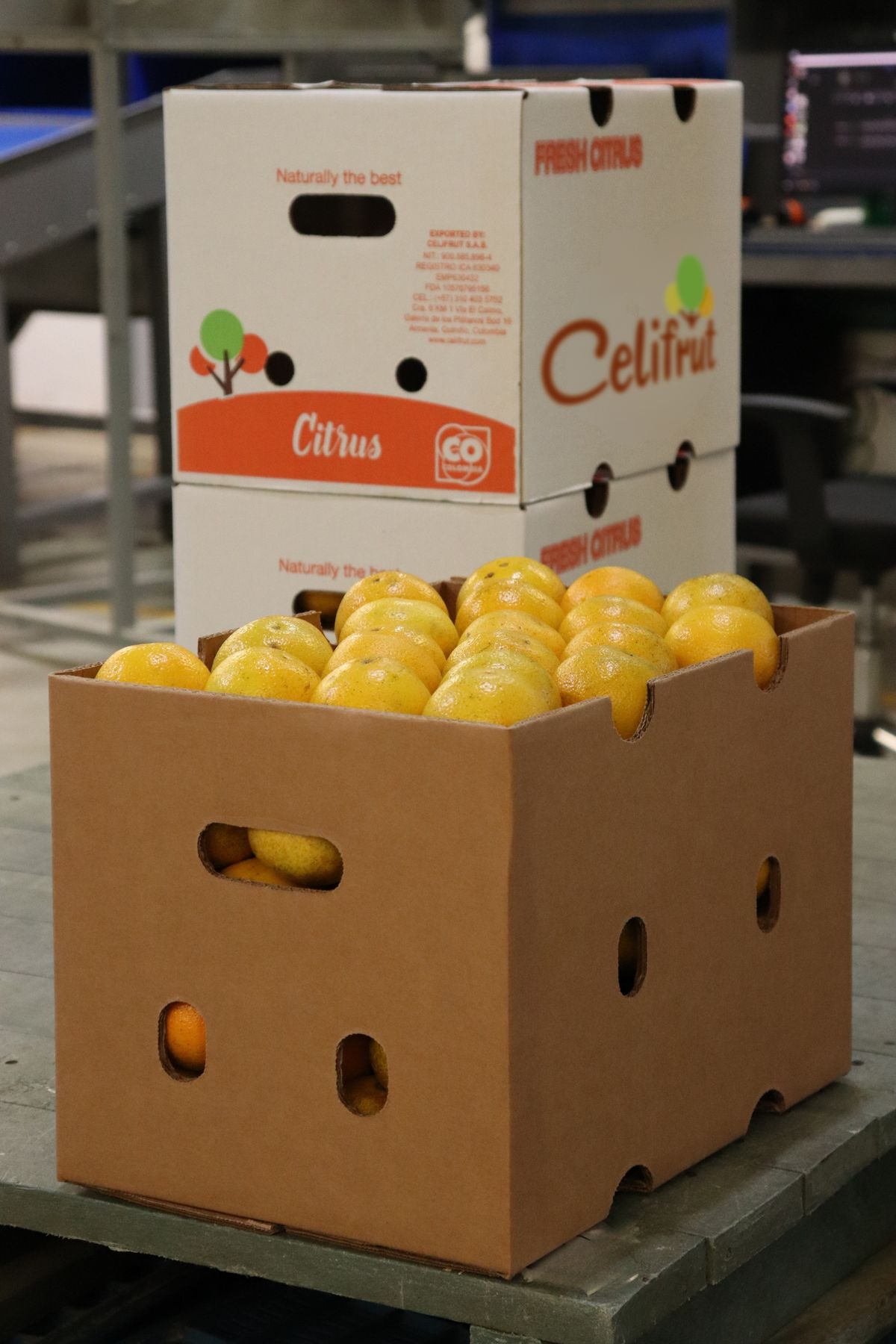
Benefits for our strategic partners
For growers, this technology represents a real transformation. Previously, they had to wait weeks for the fruit to gain color, with risks of pests and delays in the rotation of their harvest. Today they can harvest at the ideal point, reduce phytosanitary risks, improve their cash flow and access export opportunities that were not previously possible because of color. Science provides the color, but the grower receives the positive impact.
Furthermore, the development of our degreening technology not only raised the standard of Colombian oranges for export, but also opened opportunities for other players in the sector. Today, several local marketers whose main destination is the domestic market have found value in improving the color of their citrus to obtain better returns in marketplaces and wholesale food markets. On several occasions, Celifrut has supported these processes by providing the service and degreening third-party fruit under rigorous technical protocols. This has allowed more growers and marketers to access more visually appealing fruit, even when its destination is not international markets. It is a direct contribution to the regional citrus ecosystem and an example of how innovation can create opportunities beyond the boundaries of exporting.
In the end, the history of degreening in Colombia is also the story of a country that found in science and joint work the way to prepare its fruit for the world. At Celifrut, we continue writing that story every day.